Since finishing my MA in Human Trafficking and particularly my dissertation on prostitution and sexual exploitation, I’ve been trying to give my mind and heart a break from the horribleness of this world. So, I’ve started reading happy, light-hearted, somewhat badly written novels where everyone is content and there’s no violence or death. Just lots of happy ever afters. I found a book titled “Cold Feet at Christmas” which seemed suitably mindless and cheery. Set during a snowy Christmas, it’s a fairly typical story – girl meets boy, starts new life in Chicago, there’s ups and downs, but ultimately everyone ends up happy. The kind of book that leaves you warm inside and not wondering what percentage of the male population of the train you’re on have paid an underage girl or vulnerable woman for sex in one of the hundreds of brothels you know are all around London. About 80 to 100 in just the Westminster area alone, as of 2013, most likely more now. And the answer is one in ten.
But I digress. All was going as planned with this lovely novel of nothingness when I got to this part…
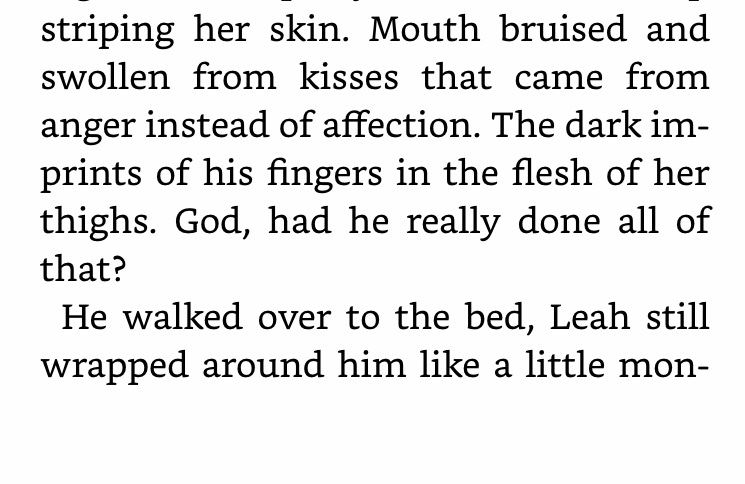
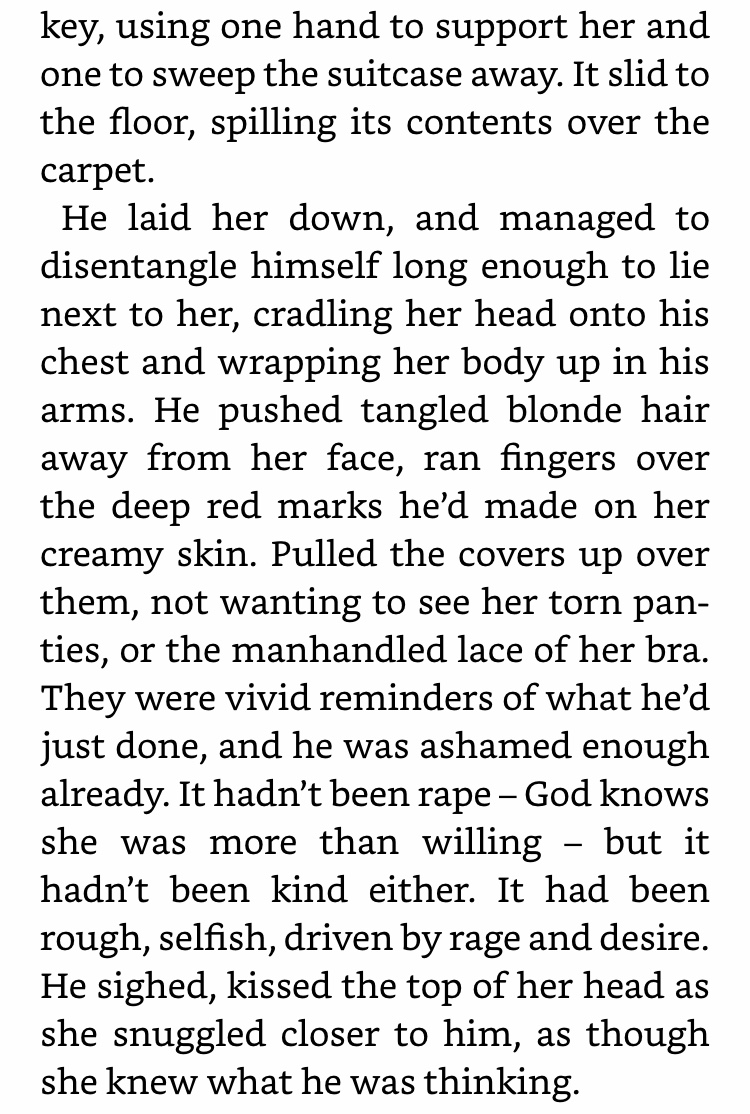
When I read this, I just sighed a deep exhausted sigh and thought “here we go again”. More normalisation of violence against women, more normalisation of violent sex, more normalisation of violence, full stop. And it just compounded what I already know, what I have been grappling with for the last few months and years. That if we are to ever end the epidemic of violence against women, we have got to start challenging the constant, tiny, almost invisible cultural narratives and norms that portray violence as normal, acceptable, unavoidable. The ones that teach boys that to be a man is to be violent, the ones that teach girls that to be a woman is to be submissive, and not only submissive but enjoyably submissive. We may not see it or want to admit it, but we live in a culture that is doing exactly this. Children are watching pornography at 9 and 10, and younger. It is getting more and more violent. And our little children are watching this, our lovely, beautiful, innocent sons and daughters, nieces, nephews, godchildren, grandchildren, are exposed to this world where boys are being taught that sex is about power and violence and girls are taught that you cannot say no, that this is what a healthy sexual relationship looks like. They are exposed to a world where women are disposable, objectified, where when a woman is raped, she’s asked what she was wearing, had she drank, did she voluntarily go home with him. A world where little boys are told that boys don’t cry, that big boys have to be strong. And then we scratch our heads and wonder why male suicide rates are exponentially high, why there are mass shootings, male on male violence, soaring rates of intimate partner violence, and teenagers being gang-raped by other teenagers in school toilets.
To make matters worse, people are taking sides, battening down the hatches on their own ideologies and belief systems. Women are standing up, calling out patriarchy and male violence, building on years of women’s movements and activism. For this I could not be more grateful, to live in a time where women have a voice, where they can feel safe to disclose abuse (I say this, knowing that the proportion of rapes being prosecuted in England and Wales is just 1.7%) but still now more than ever, there is space to raise these issues, things are starting to change, all be it slowly.
But what I also see is a huge chasm growing. I have conversations with wonderful male friends, who tell me they feel demonised and blamed for the harm that men perpetrate, and so we have conversations about inequality and our different realities. We very often disagree. And every single time I come away and I wonder what on earth we are all doing wrong. How can we stop this growing divide that I see, with men on one side and women on the other? When the reality is that both men and women suffer. When we write books that romanticise violence and abuse (yes 50 Shades of Grey I am talking about you and the less so obvious Cold Feet at Christmas), when we allow the objectification of women through pornography and prostitution, when we tell little boys, literally or figuratively that they are not allowed to cry, then everybody hurts. Everybody. This is not about women versus men, or women trying to make men like women, feminise them and undermine their masculinity. It’s about asking what femininity and masculinity are in the first place? What does it look like to be a man? To be a woman?
Jackson Katz in his book ‘The Macho Paradox’ describes the history of the word ‘macho’ – he says that for Latinos, the word macho, in the original Spanish meaning of the word meant ‘well-respected, embodying traits such as courage, valour, honour, sincerity, pride, humility and responsibility’. He goes on to say that the English mainstream usage of this word has lost much of its original meaning, associating the word macho with ‘hyper-masculine aggression’. (He also explains the colonisation of Latin America and the eroding of culture via language, but that is another day’s work).
But let’s take a look at those words again – courage, valour, honour, sincerity, pride, humility, responsibility, respect. These are traits to live by, to encourage, to teach and instil in our children, in ourselves. Male or female. We have to cross the divide, we have to start having difficult conversations, like the ones I have with my male friends and we have to wake up. We have to be more alert to the very subtle yet disastrous consequences of normalising gender inequality and violence; for men and women. We have to start asking ourselves difficult questions about how we are raising our children. As women we need to work with men, we have to explain what it is like for us, to walk home with our keys on the ready in case of attack, to never sit upstairs on a bus late at night, or more to the point, to never get a bus home late at night, but instead to watch the little Uber car on your phone as it drives you home. To make sure it is in fact, driving you home. We need to not tar all men with the same brush, to not blame all men for the actions of others. Yes, we live in a patriarchal world, but we will not change it on our own.
And men – listen to us. Listen to us when we tell you our stories, our reality. We are not always telling you because we want to blame you or ridicule you, we tell you because we want you to understand and we want you to stand with us. We want valour and courage, humility and honour. And we want to stop burying our young men because they were too scared or ashamed to ask for help. We want to stop incarcerating teenage boys for rape and murder. We want change that benefits everyone.
I usually end blogs with a direction to hope, which is both desperately needed and mercifully in abundance, if and when we look closely enough. But I will end with a story from some research I read for my dissertation.
There is a trend in Cambodia known locally as ‘bauk’. It is where groups of men go to brothels, ‘buy’ a woman and gang rape her repeatedly, or they kidnap a girl or woman and take her to the outskirts of town where they gang rape her and leave her for dead. Research with these men revealed that they got the idea from watching Western pornography where women were gang raped. The difference they said, between what they saw in the videos, and what they do, is that they have to beat the woman first into submission. In the pornography, she willingly agrees to it.
“It hadn’t been rape – God knows she was more than willing – but it hadn’t been kind either” – Cold Feet at Christmas, a light hearted, romantic novel.
 ilooktothehills